HERE ARE the latest economic news stories from some of your countries.
Please email me or add a comment if your country is not included here and you find a story of interest to us.
You can also try to answer some of the questions at the end of this post, if you like!
Russian Inflation Problems
Import tariffs on food have been removed, and there is a good chance that the central bank interest rate will be increased, in order to fight inflation. Government spending will also be tightly controlled this year.
The rate of inflation was 8.4% in 2010, but 2.4% just in January alone (which would work out as an annualised rate of more than 25% if repeated throughout 2011). The government inflation target is 7%.
http://www.bbc.co.uk/news/business-12560719
Strong Growth in Hong Kong in 2010
The Hong Kong economy grew by 6.8% in 2010. Much of this was due to the expanding property market, and particularly from people from other areas of China investing their money into Hong Kong.
However, this has raised fears that there is a speculative bubble that might burst with disastrous results not just for Hong Kong but also the rest of China. Increased property prices are also affecting the general price level, leading to fears about rising inflation.
The Hong Kong government is trying to cool down the property market by making sure there is a supply of new land and new houses for sale - difficult in such an crowded place! Other measures include a 20% tax if owners sell a property within 2 years of buying it, and restrictions that stop buyers of luxury properties borrowing more than 50% of the sale price.
http://www.bbc.co.uk/news/business-12548766
Vietnam Government Raises Interest Rates
The Vietnamese government is taking measures to fight inflation, which is currently 12%. The base rate of interest has gone up from 11% to 12%.
There are further fears of increased inflation since electricity prices are due to rise 15% on March 1. There are also criticisms that government itself has contributed to inflation through its devaluation of the currency of 8.5% earlier this month. This was done because of Vietnam's 2010 trade deficit of over $12 billion.
http://www.bloomberg.com/news/2011-02-22/vietnam-premier-to-push-central-bank-to-fight-inflation.html
Bad News and Bad News in Japan
In a surprising development, Japan has posted its first trade deficit in 2 years.
http://www.bbc.co.uk/news/business-12548277
Also this week, Moodys - an agency which rates how safe it thinks different countries' government bonds are - downgraded Japanese government bonds from AA to AA-. This is due to worries about government borrowing and spending. Japan has the world's 2nd highest government debt to GDP ratio, with 196%.
http://www.bbc.co.uk/news/business-12533405
QUESTIONS FOR EXTRA ANALYSIS
1. Why is the Russian government especially worried about the food supply at the moment?
2. Find out more about the Russian government's inflation target: how long has it been 7%? Is there any room for error? What happens if the central bank fail to achieve the target?
3. Find evidence to support the view that the Hong Kong property market is a bubble dangerously close to bursting. Find evidence against this view.
4. Do you think the Hong Kong government's measure will work?
5. Who decides prices of utilities such as electricity in Vietnam?
6. What are the possible positive effects for Vietnam of its currency devaluation?
7. What contributed to Japan's recent trade deficit? Why was it a surprise?
8. Why has government spending and borrowing recently increased again in Japan?
9. From the stories above, what seem to be the common economic problems affecting different countries at the moment?
Showing posts with label Russia. Show all posts
Thursday, 24 February 2011
Friday, 3 December 2010
No 162: Some Interesting Numbers from "Private Eye"
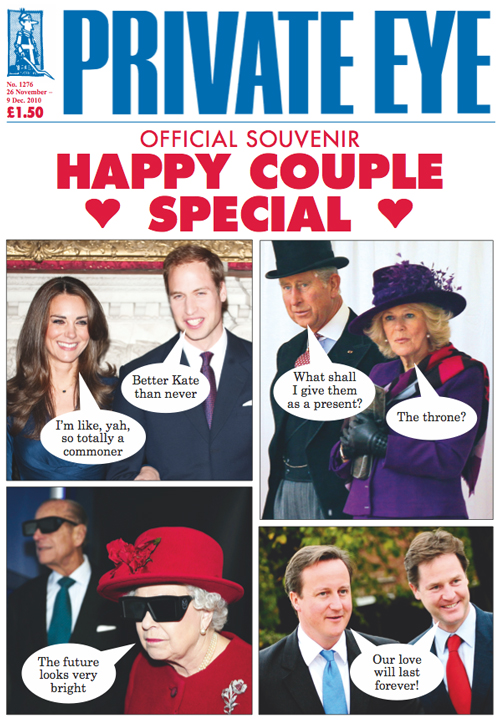
I DON'T have a particular newspaper that I read every day. However, I do make sure that every week I read "The Economist" (which hopefully you have heard of already), and "Private Eye".
You can probably tell from this week's cover the kind of magazine the Private Eye is....
In my opinion, satirical magazines like this, who watch very carefully what government and other powerful people do, are extremely important. This may be why usually one of the first acts of a dictator is to close down these kinds of publications. Plus, Private Eye is funny!
However, I am not the only person who believes in the importance of having a strong opposition to the government.
As reported in last weeks "Economist":
"In a video shown on state television, President Dmitry Medvedev said that Russia’s political system was showing signs of “stagnation”, and that the lack of serious opposition meant that Russia’s ruling party, United Russia, was in danger of “bronzing over”."
Now I don't want to say too much about Russian politics, since it not something I know a lot about. However, it does seem to me a bit strange that one of the leaders of a political party which has been well known for trying to silence opposition, is now complaining because now there is no opposition.......
In any case, back to "Private Eye". One feature I like in it is called "Number Crunching", and here are a few examples:
Saturday, 7 August 2010
No 140: World Economic News
UK GDP expanded by 1.1% in the 3 months up to the end of June, a better performance than many expected.
This is compared to the 0.3% growth in quarter 1 of this year.
Meanwhile South Korean growth slowed to 7.2% in 2010 Q2, from 8.1% in Q1.
USA growth dropped to 2.4% Q2 from 3.7% Q1.
Export figures boomed for India (up by 30.4% so far this year) and Malaysia (17.2% more compared to this time last year).
Unemployment fell in June in Brazil (to 7%) and Mexico (from 5.4% to 5.1%) but in the Eurozone stayed at 10%. Spain's jobless figure is still 20%.
Inflation decreased in Russia (down to 5.5% from 5.8%) and Switzerland (now 0.4%).
The generally positive news is reflected in the statistics for World GDP:
Monday, 5 April 2010
No 104: Russian Interest Rate Cut
.
THIS article will of course be of interest to our friends from Russia.
However, it is also interesting to the rest of us, to remind us that not all countries have very low interest rates, and therefore that some countries are still able to use interest rate cuts in order to boost the economy.
The full article is here, but it doesn't really explain much, Perhaps some of you Russia experts can suggest why interest rates there are relatively high, and how this affects things such as house buying.
Wednesday, 30 December 2009
No 48: The Economic Future of Russia and China
THE SUNDAY Telegraph printed this article about the economic prospects for China, Russia, the USA and India.
As always, there is the opportunity for you to improve your economic analysis here, if you agree to take the challenge young Jedi.
For Russia, the article suggests possible difficulties may come from over-reliance on oil and gas exports, and resistance to required reform. Think about how you would explain these problems in the context of an essay.
For China, problems may arise from the economy continuing to grow too quickly, particularly increasing inflationary pressures and asset bubbles. Again, think about how you would explain these difficulties if you were writing about them.
Let me know what you think about the article and/or the future economic prospects for your country....
Sunday, 22 November 2009
No 17: Minimum price for vodka
ALMOST as if they knew that us in AS classes will be studying the topic of demerit goods this week, the Russian government has announced it is going to introduce a minimum price for cheap vodka.
http://www.rferl.org/content/Russian_Commission_Approves_Setting_Minimum_Price_For_Vodka/1882839.html
This kind of behaviour may have led to them doing this:
An alternative argument about this topic which you may not find in your textbooks:
- Control of demerit goods is argued for not only because of the high level of negative externalities, but since consumers are presumed to have less than perfect knowledge about these goods' private costs.
- However, it may be that consumers have made a fairly rational decision based on weighing up utility with possible costs, discounting any costs coming far into the future. As we saw last week Keynes said in a different context "in the long run, we are all dead" :( . I don't know any smokers, for example, who are unware of the health risks of their habit.
- Therefore it could be argued that all government action achieves here is a restriction of individual choice and interference with consumer's pleasure and business's profit.
Subscribe to:
Posts (Atom)