Showing posts with label A2. Show all posts

Sunday, 9 October 2022

No 229: OBR forecasts likely to show £60bn-£70bn hole after Kwarteng’s mini-budget

 USEFUL for all of us, but particularly for Upper Sixth students just starting to look at Public Finances in their Macro classes, is this article from the Guardian: https://tinyurl.com/mr3dnmt8 

It is important to understand what is meant by a "hole" in the finances. This does not mean there is an extra £60-70bn of borrowing planned; it actually means that the government provided figures might not actually add up, with £60-70bn for which no information has been given yet.

Here is a key quotation from the article that summarises the government's options:


The government's response would be that none of these measures might be necessary, if their actions lead to the 2.5% economic growth they are aiming for. Achieving this growth target therefore has huge significance for not only improving the government's finances, but also in determining the political future of the Truss administration.

Saturday, 30 January 2010

No 69: Guide to UK government spending 2008-09

AS REQUESTED, here is a link to the Guardian graphic and podcast about government spending.

If you are an AS student, I will be using this in classes in a few weeks, but it won't hurt if you want to watch it before then. As you can see from the screenshot, it is a thing of some beauty.


Tuesday, 26 January 2010

No 66: Forward to the future with the huge growth of the UK economy

THIS morning the Q4 GDP growth figures were announced, showing, as expected, a POSITIVE figure taking my country WELL out of recession by showing an increase of ....er.....


0.1%

This is how it looks on a graph:


It's quite easy to miss that small blue bar unless you are looking carefully.

Nonetheless, the longest recession in British history has now ended. Though it might start again soon.

Here a link to the BBC news story:

and this short video has a lady in a field of yellow flowers (why?) talking about the news


This news clip from the BBC is about the problems that may still be ahead, even after today's statistics:


Note too the recent stories concerning unemployment - which fell from 7.9% to 7.8% - and inflation - which rose from 1.9% to 2.9% (CPI measure). This BBC page has loads of information so you can follow up on these events.


http://news.bbc.co.uk/1/hi/in_depth/business/2010/uk_economy


Again, the evidence here points to a slight recovery, but not yet


To end on a serious subject, every year the A-level examiners say that while students have good theoretical understanding, they lose marks because their knowledge of real UK and world economic events is poor. You need to know about both theory and reality to do well. Don't make the same mistake as many students - you need to read read read read read - and feel lucky you have a friendly blogger to help you do that ;-)


Thursday, 7 January 2010

No 52: More about environmental economics

AS I mentioned in an earlier post (No 45), in getting ready for your Module 1 exams you really need to think about market failure and government action regarding the environment.

Here's a selection of recent articles on this topic:


With this story, you should think about the problems that the French carbon tax has caused, and consider whether you favour a tax or a free market trading scheme in order to try and control carbon emissions.


The 'road train' is an example of what we are all hoping: for scientific research to come up with to solutions to remove environmental problems while allowing us to continue to lead consumerist lifestyles. The unanswered question is whether new technology will appear fast enough to avoid environmental disaster.

As economists we should think about what kind of system is most likely to produce technological advances. Will a free market system of fear of competition and hope for profit stimulate businesses to continually look for innovation? Or would a system where government spends a considerable amount of tax revenue on R + D, and places rules on how much firms have to spend on it, be more successful? Or is it foolish to put so much of our hope into technology rescuing us?


The writer of this article in the Telegraph certainly seems to have more belief in free markets leading to environmental solutions than agreements between governments - not surprising given the recent events in Copenhagen!

 
Finally, this press release from the UK government is an example of one of the many government policies based on improving information about environmental issues for households.

This is the economic argument: that many of us continue to act in ways which create costs (both for us and the rest of society) because we do not have full information about the consequences of our actions. In this example, government wants every house to have a meter which shows them exactly how much electricity they are using. The hope is that consumers will reduce their use of electricity, saving themselves money and helping the country cut down on energy use and CO 2 emissions.

Which of these approaches to environmental problems do you think will be the most effective? 

Tuesday, 24 November 2009

No 20: Talks last week

LAST week was a good one for interesting talks.

Apart from Mr. Krawiec's on Friday afternoon - see previous post, and make sure to ask any really hard questions about it to economics teachers who are not me :)  - two students made presentations in my A2 classes.

In the morning A2 class, Yerke Bektayev spoke about this article on gender discrimination:

http://news.bbc.co.uk/1/hi/business/8366765.stm


We won't fully study theories of discrimination until A2 Module 3, but it is an interesting issue, particularly the question of whether or not there should be "positive discrimination" in favour of certain groups.

In the afternoon class, Sanzhar Ospanov picked this "Economist" story about China's amazing productivity improvements:

http://www.economist.com/businessfinance/economicsfocus/displaystory.cfm?story_id=14844987


This introduces the idea of total factor productivity (TFP) which is fast becoming the accepted measure, as well as providing very useful details about  how a country can successfully improve the productivity of its economic resources.

Thanks to all these interesting speakers!

(Note: also many thanks to Mr. Krawiec for allowing me to post his presentation on this blog.)

No 18: Two videos you really MUST watch


OUR economics coursebooks and syllabi are still  yet to catch up with events started by the credit curnch over the past year. This means we have to educate ourselves about them, since, in my opinion at least, any student of macroeconomics is badly informed who doesn't know about, for example, quantatitive easing.

There are two extremely useful videos to help us with this. I show both of them to all my classes. If you haven't seen them, watch them now, and I make no apologies for showing them again in class in future. If you've seen them, watch them again.

KNOWLEDGE OF THE TOPICS CONTAINED IN THESE VIDEOS MAY SEPARATE THE TOP STUDENTS FROM THE OTHERS WHEN IT COMES TO OUR FINAL EXAMS.

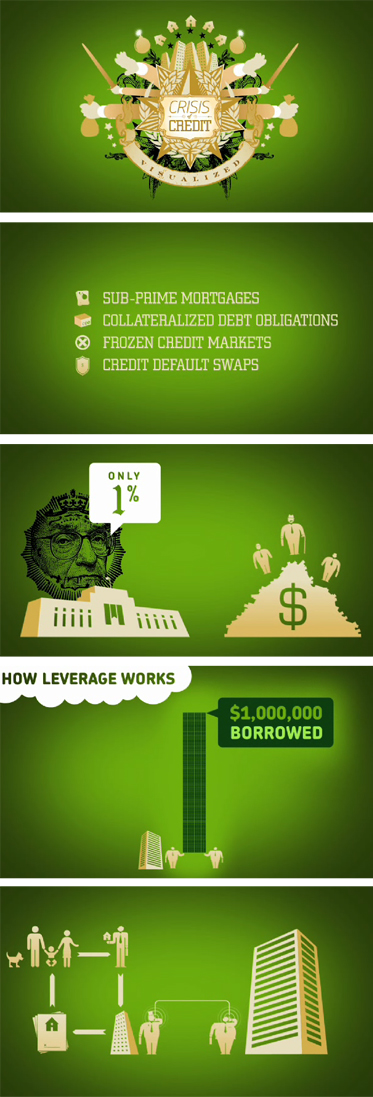
The first is called the "Crisis of Credit" and explains the events that led to the credit crunch:

http://www.crisisofcredit.com/

The second is a part of the excellent Marketplace website's whiteboard series, and explains what governments are trying to achieve with quantitative easing:

http://marketplace.publicradio.org/display/web/2008/12/22/whiteboard_quantitative_easing/

Spot of Economics Health Warning: Watching These Videos May Seriously Improve Your Economics Knowledge!