THIS infographic from "The Economist" compares Chinese provinces with similar countries, in terms of GDP, GDP per capita, population and trade.
(To see a similar map about the USA see Post 37).
Showing posts with label China. Show all posts
Showing posts with label China. Show all posts
Sunday, 27 February 2011

Thursday, 24 February 2011
No 182: World Economic News
HERE ARE the latest economic news stories from some of your countries.
Please email me or add a comment if your country is not included here and you find a story of interest to us.
You can also try to answer some of the questions at the end of this post, if you like!
 Russian Inflation Problems
Import tariffs on food have been removed, and there is a good chance that the central bank interest rate will be increased, in order to fight inflation. Government spending will also be tightly controlled this year.
The rate of inflation was 8.4% in 2010, but 2.4% just in January alone (which would work out as an annualised rate of more than 25% if repeated throughout 2011). The government inflation target is 7%.
http://www.bbc.co.uk/news/business-12560719
 Strong Growth in Hong Kong in 2010
The Hong Kong economy grew by 6.8% in 2010. Much of this was due to the expanding property market, and particularly from people from other areas of China investing their money into Hong Kong.
However, this has raised fears that there is a speculative bubble that might burst with disastrous results not just for Hong Kong but also the rest of China. Increased property prices are also affecting the general price level, leading to fears about rising inflation.
The Hong Kong government is trying to cool down the property market by making sure there is a supply of new land and new houses for sale - difficult in such an crowded place! Other measures include a 20% tax if owners sell a property within 2 years of buying it, and restrictions that stop buyers of luxury properties borrowing more than 50% of the sale price.
http://www.bbc.co.uk/news/business-12548766
 Vietnam Government Raises Interest Rates
The Vietnamese government is taking measures to fight inflation, which is currently 12%. The base rate of interest has gone up from 11% to 12%.
There are further fears of increased inflation since electricity prices are due to rise 15% on March 1. There are also criticisms that government itself has contributed to inflation through its devaluation of the currency of 8.5% earlier this month. This was done because of Vietnam's 2010 trade deficit of over $12 billion.
http://www.bloomberg.com/news/2011-02-22/vietnam-premier-to-push-central-bank-to-fight-inflation.html
 Bad News and Bad News in Japan
In a surprising development, Japan has posted its first trade deficit in 2 years.
http://www.bbc.co.uk/news/business-12548277
Also this week, Moodys - an agency which rates how safe it thinks different countries' government bonds are - downgraded Japanese government bonds from AA to AA-. This is due to worries about government borrowing and spending. Japan has the world's 2nd highest government debt to GDP ratio, with 196%.
http://www.bbc.co.uk/news/business-12533405
QUESTIONS FOR EXTRA ANALYSIS
1. Why is the Russian government especially worried about the food supply at the moment?
2. Find out more about the Russian government's inflation target: how long has it been 7%? Is there any room for error? What happens if the central bank fail to achieve the target?
3. Find evidence to support the view that the Hong Kong property market is a bubble dangerously close to bursting. Find evidence against this view.
4. Do you think the Hong Kong government's measure will work?
5. Who decides prices of utilities such as electricity in Vietnam?
6. What are the possible positive effects for Vietnam of its currency devaluation?
7. What contributed to Japan's recent trade deficit? Why was it a surprise?
8. Why has government spending and borrowing recently increased again in Japan?
9. From the stories above, what seem to be the common economic problems affecting different countries at the moment?
Please email me or add a comment if your country is not included here and you find a story of interest to us.
You can also try to answer some of the questions at the end of this post, if you like!

Import tariffs on food have been removed, and there is a good chance that the central bank interest rate will be increased, in order to fight inflation. Government spending will also be tightly controlled this year.
The rate of inflation was 8.4% in 2010, but 2.4% just in January alone (which would work out as an annualised rate of more than 25% if repeated throughout 2011). The government inflation target is 7%.
http://www.bbc.co.uk/news/business-12560719

The Hong Kong economy grew by 6.8% in 2010. Much of this was due to the expanding property market, and particularly from people from other areas of China investing their money into Hong Kong.
However, this has raised fears that there is a speculative bubble that might burst with disastrous results not just for Hong Kong but also the rest of China. Increased property prices are also affecting the general price level, leading to fears about rising inflation.
The Hong Kong government is trying to cool down the property market by making sure there is a supply of new land and new houses for sale - difficult in such an crowded place! Other measures include a 20% tax if owners sell a property within 2 years of buying it, and restrictions that stop buyers of luxury properties borrowing more than 50% of the sale price.
http://www.bbc.co.uk/news/business-12548766
The Vietnamese government is taking measures to fight inflation, which is currently 12%. The base rate of interest has gone up from 11% to 12%.
There are further fears of increased inflation since electricity prices are due to rise 15% on March 1. There are also criticisms that government itself has contributed to inflation through its devaluation of the currency of 8.5% earlier this month. This was done because of Vietnam's 2010 trade deficit of over $12 billion.
http://www.bloomberg.com/news/2011-02-22/vietnam-premier-to-push-central-bank-to-fight-inflation.html

In a surprising development, Japan has posted its first trade deficit in 2 years.
http://www.bbc.co.uk/news/business-12548277
Also this week, Moodys - an agency which rates how safe it thinks different countries' government bonds are - downgraded Japanese government bonds from AA to AA-. This is due to worries about government borrowing and spending. Japan has the world's 2nd highest government debt to GDP ratio, with 196%.
http://www.bbc.co.uk/news/business-12533405
QUESTIONS FOR EXTRA ANALYSIS
1. Why is the Russian government especially worried about the food supply at the moment?
2. Find out more about the Russian government's inflation target: how long has it been 7%? Is there any room for error? What happens if the central bank fail to achieve the target?
3. Find evidence to support the view that the Hong Kong property market is a bubble dangerously close to bursting. Find evidence against this view.
4. Do you think the Hong Kong government's measure will work?
5. Who decides prices of utilities such as electricity in Vietnam?
6. What are the possible positive effects for Vietnam of its currency devaluation?
7. What contributed to Japan's recent trade deficit? Why was it a surprise?
8. Why has government spending and borrowing recently increased again in Japan?
9. From the stories above, what seem to be the common economic problems affecting different countries at the moment?
Wednesday, 5 January 2011
No 173: Top 10 Economics Stories of 2010

CLICK on this link to get to a sideshow from the "Daily Telegraph" of its top 10 economics new stories of 2010.
Here is a list of which stories they have included:
1. Deficit, debt and austerity worries
2. Government debt problems for European countries
3. Currency wars
4. Global imbalances in trade
5. China's continued growth
6. Difficulties with job creation
7. Inflation and interest rate decsisions
8. Problems for the Bank of England's monetary policy
9. The formation of the Office for Budget Responsibility
10. Unpredictable UK growth
Therefore, please make sure you have a look. There may even be an exciting quiz about them next week.....
 If you want more, here is a link to the Telegraph's Top 10 Banking Stories of 2010.
And if you'd like even more, this is a link to "The Week" magazine's Most Newsworthy Dogs of 2010, including the sad story of Target, the war hero dog :,(

Sunday, 29 August 2010
No 145: World Economics News
UK CPI INFLATION for July was 3.1% down from 3.2% in June. The Bank of England stated that they could not see it falling to the 2% target this year.
The ONS (Office of National Statistics) revised Q2 GDP Growth up to 1.2% from their earlier estimate of 1.1%. This was the fastest rate of quarterly growth in the UK since 2001, but economists are expecting a slower rate during the rest of the year.

(See here for more.)
Q2 GDP was revised in the USA, but downwards, from an estimate of 2.4% to 1.6%. This has led many to expect more quantitiative easing to be introduced soon by the US government and Federal Reserve.
Germany grew in Q2 by 2.2%, its highest ever rate since reunification in 1990.
However, Greece (1.5% fall in GDP), Spain (only 0.2% rise) and Japan (only 0.4%) all had disappointing growth figures. For Japan, this was also the month in which it fell behind China's total GDP and therefore dropped to being the world's third biggest economy. Income per person in Japan, however, is still ten times as much as in China.
The ONS (Office of National Statistics) revised Q2 GDP Growth up to 1.2% from their earlier estimate of 1.1%. This was the fastest rate of quarterly growth in the UK since 2001, but economists are expecting a slower rate during the rest of the year.

Q2 GDP was revised in the USA, but downwards, from an estimate of 2.4% to 1.6%. This has led many to expect more quantitiative easing to be introduced soon by the US government and Federal Reserve.
Germany grew in Q2 by 2.2%, its highest ever rate since reunification in 1990.
However, Greece (1.5% fall in GDP), Spain (only 0.2% rise) and Japan (only 0.4%) all had disappointing growth figures. For Japan, this was also the month in which it fell behind China's total GDP and therefore dropped to being the world's third biggest economy. Income per person in Japan, however, is still ten times as much as in China.
Monday, 16 August 2010
No 141: Japan no longer world's second biggest economy
A LONG predicted event has finally happened: China is now officially the world's second biggest economy.
For more details read:
http://uk.finance.yahoo.com/news/japanese-economy-slips-to-third-in-the-world-skynews-4d6c38cb3df5.html
This news might not seem so surprising given that Japan has had low or even negative growth over the past ten years, while China has averaged 10%.
Nevertheless, the gap between the two countries' GDP 30 or 40 years ago was huge. Click on the next link, and you can see an interactive graph I made on gapminder that shows this:
www.bit.ly/cDtgEa
Here is a screenshot of what it looks like:

Try dragging back the arrow at the bottom to 1960 then press play to see how GDP changed. You can also click on other countries in the panel on the right to see how they did in comparison.
It's worth having a good play around with this - we will be using the gapminder software a lot in my classes during the next school year.
For more details read:
http://uk.finance.yahoo.com/news/japanese-economy-slips-to-third-in-the-world-skynews-4d6c38cb3df5.html
This news might not seem so surprising given that Japan has had low or even negative growth over the past ten years, while China has averaged 10%.
Nevertheless, the gap between the two countries' GDP 30 or 40 years ago was huge. Click on the next link, and you can see an interactive graph I made on gapminder that shows this:
www.bit.ly/cDtgEa
Here is a screenshot of what it looks like:
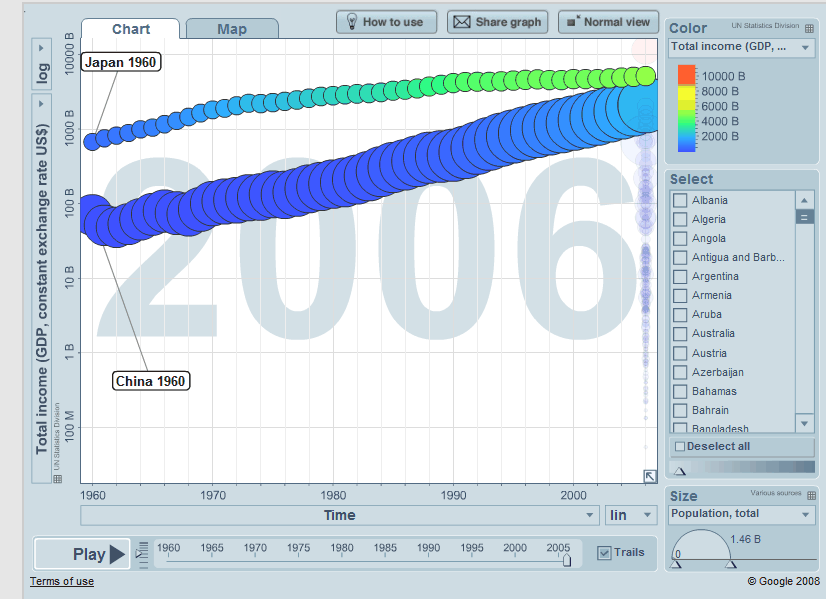
Try dragging back the arrow at the bottom to 1960 then press play to see how GDP changed. You can also click on other countries in the panel on the right to see how they did in comparison.
It's worth having a good play around with this - we will be using the gapminder software a lot in my classes during the next school year.
Monday, 28 June 2010
No 131: The end of cheap Chinese labour?
I HAVE just found this really interesting slide slow about this topic:

Click here to view it.
Each of the photos illustrates a powerful argument about why this might be happening. The arguments are:
1. The doubling of Foxconn workers' salaries after the suicides in factories making Apple products.
2. A recent article in the "People's Daily" (a Communist Party newspaper) calling for a revolt against the rich by poor workers.
3. Strike at a Hylandai factory in Beijing and subsequent 25% pay rises.
4. Honda workers going on strike even though they were offered 24-32% more pay.
5. The Beijing munipcal government raising its minimum wage by 20%.
6. The "one-child policy" leading to a shortage of labour supply.
7. A government half trillion dollar rural development programme leading to labour shortages in citiies.
8. New laws in 2008 for workers' rights.
9. Low wages being less benificial to China's economy than in the past.
On the last point, it has often been commented that wages inside China have been controlled in order to keep inflation down, while growth came from exports rather than domestic consumption. Perhaps the fall in world demand for Chinese products since the Credit Crunch may be changing this......
What do you think about it?
Sunday, 14 March 2010
No 93: Newspaper review
STARTING off with a couple of negative pieces of information about the UK economy. From the Guardian:
 http://www.guardian.co.uk/business/2010/mar/10/industrial-production-fell-in-january-snow-disruption
A more worrying statistic was the UK trade balance for January:
 http://news.bbc.co.uk/1/hi/business/8557200.stm
Notice how closely related the poor economic news and the fall in the pound have been. Combined with all the predictions of no party winning overall control in May's general election, there is a lot of uncertainty about the UK's economic future over the rest of this year, leading this writer to ask

http://blogs.telegraph.co.uk/finance/edmundconway/100004089/is-this-the-start-of-a-sterling-crisis/
However, there is slightly more optimistic news with relation to the amount of government borrowing, as reported in the Telegraph:

http://www.telegraph.co.uk/finance/economics/7436294/Lower-borrowing-fails-to-lift-Treasury-gloom.html
Lower than expected unemployment is an important reason for this, since it has meant government has needed less than previously calculated for benefit payments.
Nonetheless, there will still be a huge government deficit that needs to be reduced. In the run up to the Budget on March 24th, this Telegraph article forecasts no government spending cuts until after the election:

http://www.telegraph.co.uk/finance/financetopics/budget/7436658/Budget-2010-Labour-to-put-off-spending-cuts-until-after-the-general-election.html
Meanwhile, a couple of interesting China related stories.
First, news about inflation that may mean a cut in AD is required:

http://news.bbc.co.uk/1/hi/business/8561381.stm
The continuing argument between the USA and China over the RMBs low dollar exchange rate is the subject of this interesting piece from the Telegraph:

http://www.telegraph.co.uk/finance/comment/liamhalligan/7436875/The-more-America-huffs-about-the-yuan-the-less-China-will-do-about-it.html
(Liam Halligan is a good writer - I recommend looking at some of his other articles).
Finally, not about economics but I bet you watch this clip more than once:

A more worrying statistic was the UK trade balance for January:

Notice how closely related the poor economic news and the fall in the pound have been. Combined with all the predictions of no party winning overall control in May's general election, there is a lot of uncertainty about the UK's economic future over the rest of this year, leading this writer to ask

http://blogs.telegraph.co.uk/finance/edmundconway/100004089/is-this-the-start-of-a-sterling-crisis/
However, there is slightly more optimistic news with relation to the amount of government borrowing, as reported in the Telegraph:

http://www.telegraph.co.uk/finance/economics/7436294/Lower-borrowing-fails-to-lift-Treasury-gloom.html
Lower than expected unemployment is an important reason for this, since it has meant government has needed less than previously calculated for benefit payments.
Nonetheless, there will still be a huge government deficit that needs to be reduced. In the run up to the Budget on March 24th, this Telegraph article forecasts no government spending cuts until after the election:

http://www.telegraph.co.uk/finance/financetopics/budget/7436658/Budget-2010-Labour-to-put-off-spending-cuts-until-after-the-general-election.html
Meanwhile, a couple of interesting China related stories.
First, news about inflation that may mean a cut in AD is required:

http://news.bbc.co.uk/1/hi/business/8561381.stm
The continuing argument between the USA and China over the RMBs low dollar exchange rate is the subject of this interesting piece from the Telegraph:

http://www.telegraph.co.uk/finance/comment/liamhalligan/7436875/The-more-America-huffs-about-the-yuan-the-less-China-will-do-about-it.html
(Liam Halligan is a good writer - I recommend looking at some of his other articles).
Finally, not about economics but I bet you watch this clip more than once:
Wednesday, 30 December 2009
No 48: The Economic Future of Russia and China

THE SUNDAY Telegraph printed this article about the economic prospects for China, Russia, the USA and India.
As always, there is the opportunity for you to improve your economic analysis here, if you agree to take the challenge young Jedi.
For Russia, the article suggests possible difficulties may come from over-reliance on oil and gas exports, and resistance to required reform. Think about how you would explain these problems in the context of an essay.
For China, problems may arise from the economy continuing to grow too quickly, particularly increasing inflationary pressures and asset bubbles. Again, think about how you would explain these difficulties if you were writing about them.
Let me know what you think about the article and/or the future economic prospects for your country....
Subscribe to:
Posts (Atom)