Showing posts with label Japan. Show all posts

Tuesday, 24 January 2023

No 247 Japan's demographic disaster

NEARLY 30% of Japan's population are aged over 65. The birth rate is so low that by 2065, on current trends, the population will have fallen from 125 million to 88 million.

Not surprisingly, the Japanese government are trying various measures to change this. But critics of the government's policies say they do not address the core problems of

"the cost of compulsory and higher education, the rising cost of living and, poorly paid and unstable jobs for non-regular workers, and punishingly long working hours that make a healthy family life practically impossible."

There are also cultural issues. Consecutive Japanese governments have refused to allow more immigrant workers into the country. It also seems that having a traditional family is not attractive to many Japanese women. As a university student, Nao Imai, said:

"When you have a child in Japan, the husband keeps working but the mother is expected to quit her job and look after the children. I just feel that it’s hard to raise children, financially, mentally and physically."

There could be huge economic problems created by the demographic problems.of having a smaller and older population. As you read the article below, consider the following questions:

(1) what will happen to the number of workers and therefore Japan's productive capacity?
(2) what will happen to tax revenue?
(3) what will happen to government spending?

https://www.theguardian.com/world/2023/jan/24/japan-birthrate-population-pm-solution-already-rejected-by-young?CMP=Share_AndroidApp_Other 

Tuesday, 22 March 2011

Thursday, 24 February 2011

No 182: World Economic News

HERE ARE the latest economic news stories from some of your countries. 

Please email me or add a comment if your country is not included here and you find a story of interest to us.

You can also try to answer some of the questions at the end of this post, if you like!

Russian Inflation Problems


Import tariffs on food have been removed, and there is a good chance that the central bank interest rate will be increased, in order to fight inflation. Government spending will also be tightly controlled this year.

The rate of inflation was 8.4% in 2010, but 2.4% just in January alone (which would work out as an annualised rate of more than 25% if repeated throughout 2011). The government inflation target is 7%. 

http://www.bbc.co.uk/news/business-12560719


Strong Growth in Hong Kong in 2010
The Hong Kong economy grew by 6.8% in 2010. Much of this was due to the expanding property market, and particularly from people from other areas of China investing their money into Hong Kong.

However, this has raised fears that there is a speculative bubble that might burst with disastrous results not just for Hong Kong but also the rest of China. Increased property prices are also affecting the general price level, leading to fears about rising inflation.

The Hong Kong government is trying to cool down the property market by making sure there is a supply of new land and new houses for sale - difficult in such an crowded place! Other measures include a 20% tax if owners sell a property within 2 years of buying it, and restrictions that stop buyers of luxury properties borrowing more than 50% of the sale price.

http://www.bbc.co.uk/news/business-12548766


Vietnam Government Raises Interest Rates
The Vietnamese government is taking measures to fight inflation, which is currently 12%. The base rate of interest has gone up from 11% to 12%.

There are further fears of increased inflation since electricity prices are due to rise 15% on March 1. There are also criticisms that government itself has contributed to inflation through its devaluation of the currency of 8.5% earlier this month. This was done because of Vietnam's 2010 trade deficit of over $12 billion.

http://www.bloomberg.com/news/2011-02-22/vietnam-premier-to-push-central-bank-to-fight-inflation.html


Bad News and Bad News in Japan
In a surprising development, Japan has posted its first trade deficit in 2 years.
http://www.bbc.co.uk/news/business-12548277

Also this week, Moodys - an agency which rates how safe it thinks different countries' government bonds are - downgraded Japanese government bonds from AA to AA-. This is due to worries about government borrowing and spending. Japan has the world's 2nd highest government debt to GDP ratio, with 196%.

http://www.bbc.co.uk/news/business-12533405


QUESTIONS FOR EXTRA ANALYSIS
1. Why is the Russian government especially worried about the food supply at the moment?
2. Find out more about the Russian government's inflation target: how long has it been 7%? Is there any room for error? What happens if the central bank fail to achieve the target?
3. Find evidence to support the view that the Hong Kong property market is a bubble dangerously close to bursting. Find evidence against this view.
4. Do you think the Hong Kong government's measure will work?
5. Who decides prices of utilities such as electricity in Vietnam?
6. What are the possible positive effects for Vietnam of its currency devaluation?
7. What contributed to Japan's recent trade deficit? Why was it a surprise?
8. Why has government spending and borrowing recently increased again in Japan?

9. From the stories above, what seem to be the common economic problems affecting different countries at the moment?

Sunday, 29 August 2010

No 145: World Economics News

UK CPI INFLATION for July was 3.1% down from 3.2% in June. The Bank of England stated that they could not see it falling to the 2% target this year.

The ONS (Office of National Statistics) revised Q2 GDP Growth up to 1.2% from their earlier estimate of 1.1%. This was the fastest rate of quarterly growth in the UK since 2001, but economists are expecting a slower rate during the rest of the year.


(See here for more.)

Q2 GDP was revised in the USA, but downwards, from an estimate of 2.4% to 1.6%. This has led many to expect more quantitiative easing to be introduced soon by the US government and Federal Reserve.

Germany grew in Q2 by 2.2%, its highest ever rate since reunification in 1990.

However, Greece (1.5% fall in GDP), Spain (only 0.2% rise) and Japan (only 0.4%) all had disappointing growth figures. For Japan, this was also the month in which it fell behind China's total GDP and therefore dropped to being the world's third biggest economy. Income per person in Japan, however, is still ten times as much as in China.

Monday, 16 August 2010

No 141: Japan no longer world's second biggest economy

A LONG predicted event has finally happened: China is now officially the world's second biggest economy.

For more details read:

http://uk.finance.yahoo.com/news/japanese-economy-slips-to-third-in-the-world-skynews-4d6c38cb3df5.html


 This news might not seem so surprising given that Japan has had low or even negative growth over the past ten years, while China has averaged 10%.

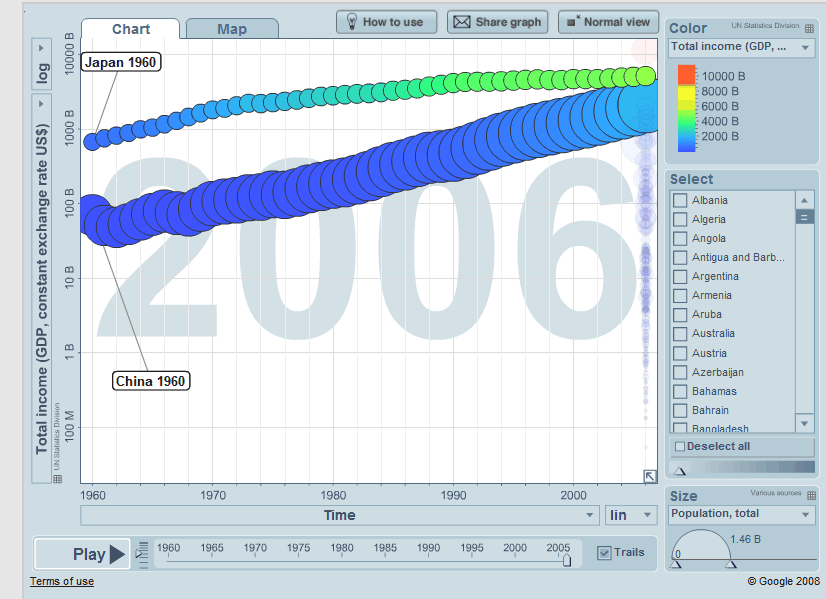
Nevertheless, the gap between the two countries' GDP 30 or 40 years ago was huge. Click on the next link, and you can see an interactive graph I made on gapminder that shows this:

www.bit.ly/cDtgEa

Here is a screenshot of what it looks like:


Try dragging back the arrow at the bottom to 1960 then press play to see how GDP changed. You can also click on other countries in the panel on the right to see how they did in comparison.


It's worth having a good play around with this - we will be using the gapminder software a lot in my classes during the next school year.